Do you have a go-to list of reading response questions for any book? As a classroom teacher, I loved read alouds, book clubs, and small group reading experiences. But if you are creating learning experiences for lots of different classes or groups of students, you may want to have some reading response questions you come back to throughout the school year.
This summer I led a session at ISTE Live all about reading responses. And last month I led a similar session as a webinar for a group of teachers getting ready for the new school year. So today on the blog, I’m sharing a few dozen reading response questions. These are ready for you to tailor to any book or reading material you are sharing with students.
As you’ll see below, the questions are organized by before, during, and after reading, and by grade band. I’ve also included a section on digital ways to support reading responses with a few favorite tools, including Book Creator, Padlet, and Canva.
Why These Questions Work Across Grades and Text Types
If you’ve followed along with the blog (or the podcast) for a while now, you know I love creating systems, using templates, and finding ways to work smarter, not harder.
This list includes questions you can use with a read aloud in second grade, a class novel in seventh grade, or an independent reading choice in eleventh grade. The goal is for students to start to recognize the questions and structures you set up for reading response activities.
These questions also work across text types. Whether students are reading a graphic novel, a news article, a podcast transcript, or a traditional chapter book, the thinking is the same.
Note: If you’re looking for more ideas around this topic, explore my quick reference guide with Pam Allyn, Engaging Students in Reading All Types of Text. It digs into strategies for helping students interact with all the kinds of text they encounter. You can check out all of my books here.
Digital Ways to Support Reading Responses
You don’t need a digital tool for every question on this list. A sticky note or a quick conversation is often a perfect way to use them. But sometimes you want students to capture their thinking in a way you can revisit, or you want to give students options for how they respond. In those moments, there are definitely ways to leverage the digital tools you may already have in your classroom.
Let students talk instead of write
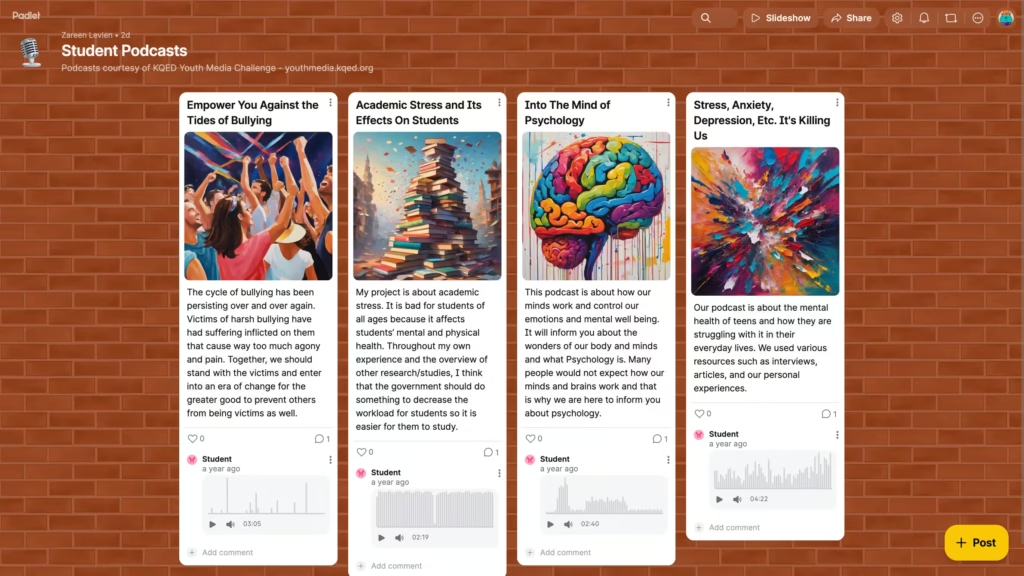
A first grader who can’t write a full paragraph can absolutely still explain how a character is feeling. Tools like Padlet and Book Creator let students record audio or video responses, which also gives you a window into their thinking that a worksheet can’t. I shared a few of the newer response options in 5 Things You Might Not Know About Padlet.
Make thinking visible in one place
Post one question on a shared Padlet wall and have the whole class respond. Students can see what their classmates are noticing, and you can spot patterns (and misconceptions) quickly. This is one of my favorite simple formative assessment strategies and a popular topic for my workshops and webinars.
Build a reading journal over time
In Book Creator, students can add a new page each time they respond to a question, with a mix of text, drawings, photos, and audio. By the end of a book, they have a record of how their thinking grew. I created an ebook for the team at Book Creator a few years ago that has plenty of options you could try out this week.
Use AI to adjust the questions, not to answer them
If a question on this list is worded in a way that is just not right for your group of students, an AI chatbot can help you rewrite it at a different level or add sentence starters. I shared prompts like these in 10 Ways to Use AI for Book Studies in Your Classroom, and I talked through more reading-focused ideas on the Easy EdTech Podcast episode on using AI in the reading classroom.
Create a choice board with options for reading responses
There are plenty of options you can add for students to choose from, like:
- Retell the most important scene as a comic strip, then answer an “after reading” question in a final panel. Students can use Google Slides or Adobe Express to build a comic strip.
- Record a one-minute response to a “during reading” question and add a drawing or photo that goes with it.
- Write and illustrate a new final page, then explain why you changed it.
- Design a poster for one character with three quotes that show how they changed.
If you want to build your own board, take a look at 15 Ready-To-Use Comic Strip Templates for Your Next Lesson for Canva templates students can start with. You can also listen to “Your Guide to Digital Choice Boards with Laura Boyd” on the Easy EdTech Podcast for tips on getting started.
Reading Response Questions for Any Book
Before Reading
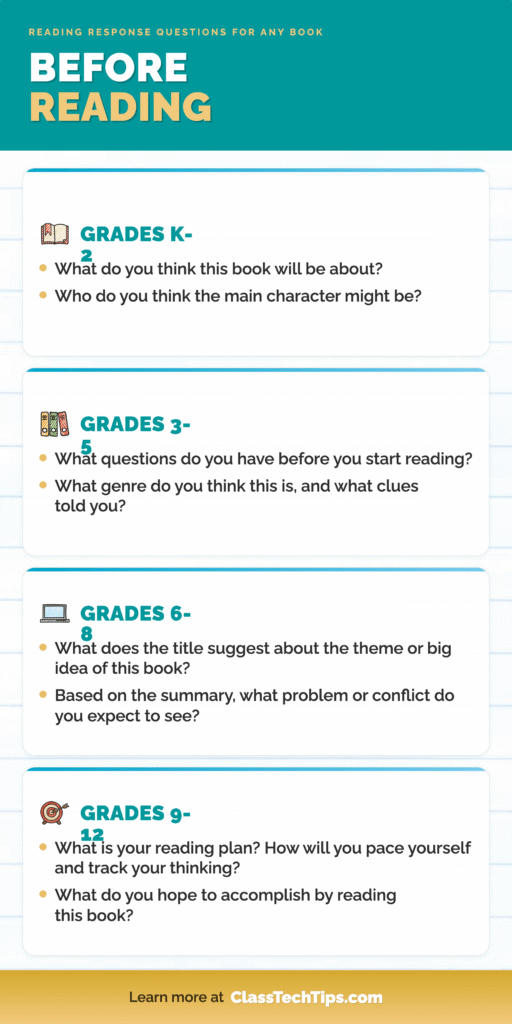
Before reading questions help students activate what they already know, make predictions, and set a purpose for reading. These work well as a quick turn-and-talk, a sticky note on the first page, or a short video reflection.
Early Elementary: Grades K-2
- What do you see on the cover?
- What do you think this book will be about?
- Who do you think the main character might be?
- Does the title remind you of anything you already know?
- Where do you think this story takes place?
- Is this a book that will tell a story or teach you something? How can you tell?
- Have we read a book by this author before?
Upper Elementary: Grades 3-5
- Based on the cover, the title, and the back of the book, what predictions can you make?
- What do you already know about this topic, time period, or setting?
- What questions do you have before you start reading?
- Have you read anything else by this author or in this series? What do you expect this time?
- What genre do you think this is, and what clues told you?
- What is one goal you have as a reader for this book?
Middle School: Grades 6-8
- What does the title suggest about the theme or big idea of this book?
- What do you notice about how the book is organized (chapters, parts, headings, images)?
- What do you know about the author or the time when this book was written?
- Based on the summary, what problem or conflict do you expect to see?
- After skimming the first page, what do you notice about the voice or point of view?
High School: Grades 9-12
- Why might a teacher, book club, or friend have chosen this book right now?
- What might be important to know before diving into this text, and where can you learn that information?
- Where does this book sit in a larger conversation (a genre, a movement, a debate, a moment in history)?
- What is your reading plan? How will you pace yourself and track your thinking?
- What do you hope to accomplish by reading this book?
- What would you like to know about the author before reading this book?
During Reading
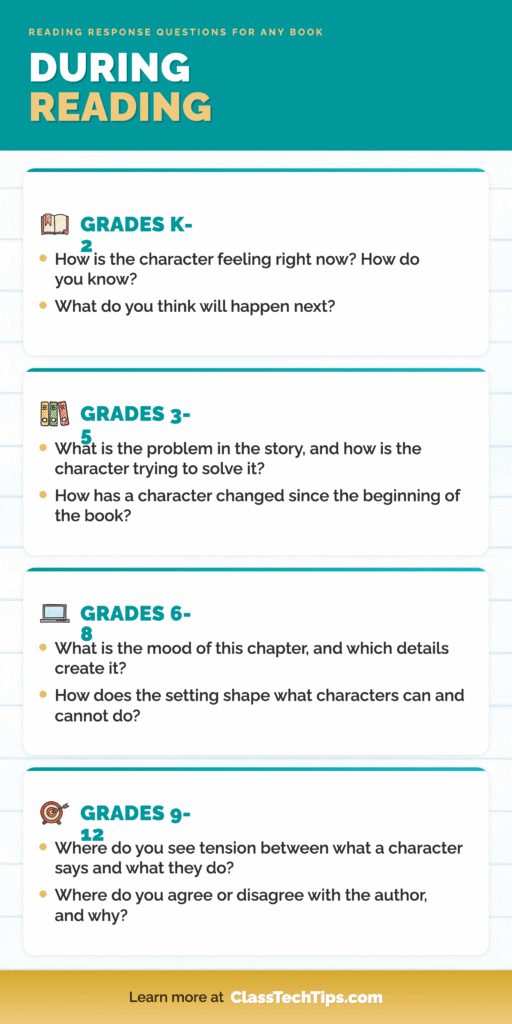
During reading questions give students a reason to pause, check their understanding, and notice what the author is doing. Try posting one question at the start of independent reading time and asking students to respond before they close the book.
Early Elementary: Grades K-2
- What has happened so far?
- How is the character feeling right now? How do you know?
- What do you think will happen next?
- What is a word that was new or tricky for you?
- Does this part remind you of something in your own life?
Upper Elementary: Grades 3-5
- What is the problem in the story, and how is the character trying to solve it?
- Was your prediction right? What surprised you?
- What is a question you have right now, and where might you find the answer?
- Choose a word or phrase the author used well. Why did you pick it?
- How has a character changed since the beginning of the book?
Middle School: Grades 6-8
- What is the mood of this chapter, and which details create it?
- What is a decision a character made that you would have made differently?
- What does the author want you to notice here? Why do you think so?
- How does the setting shape what characters can and cannot do?
- What connection can you make to another book, movie, or event?
- What is the title of this chapter, and why do you think the author chose it?
High School: Grades 9-12
- What is the author doing with structure, pacing, or point of view in this section, and to what effect?
- Where do you see tension between what a character says and what they do?
- What claim or argument is the text making, and what evidence supports it?
- What has happened that changed your first impression of a character?
- Where do you agree or disagree with the author, and why?
- What movies, podcasts, or television shows connect to the themes, ideas, or events in this text?
After Reading
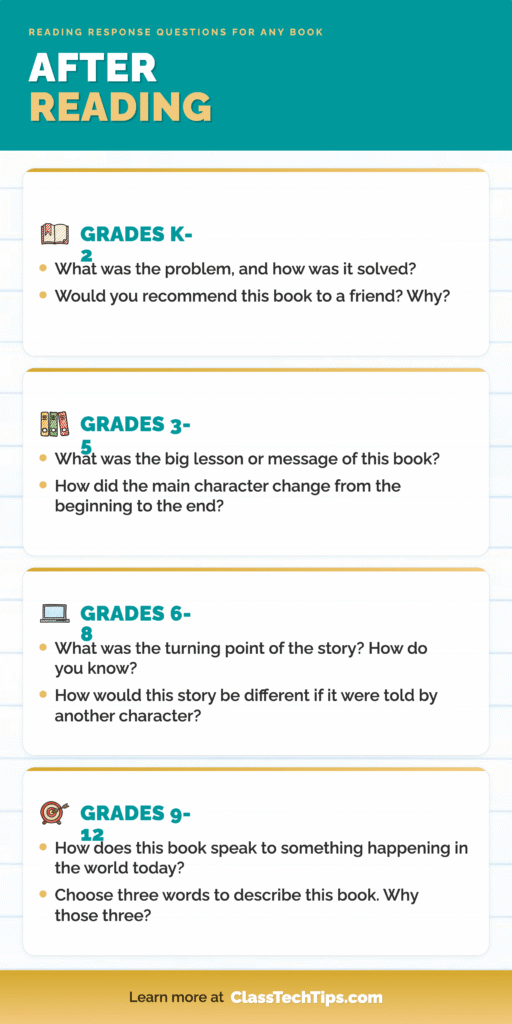
After reading questions ask students to step back, evaluate, and connect. These are great for a final reflection, a book talk, or a creative project. I’m a big fan of choice boards (it was a masterclass topic in my Easy EdTech Club), and you might use these questions as inspiration for a choice board.
Early Elementary: Grades K-2
- What was your favorite part? Why?
- Who was your favorite character? What did you like about them?
- What was the problem, and how was it solved?
- What did the character learn?
- Would you recommend this book to a friend? Why?
- If you could add one more page to the end, what would happen?
Upper Elementary: Grades 3-5
- What was the big lesson or message of this book?
- How did the main character change from the beginning to the end?
- What would you change about the ending?
- What did the author do to keep you reading?
- What is one thing you will remember from this book a year from now?
- How does this book connect to something you are learning in school or outside of school?
Middle School: Grades 6-8
- What was the turning point of the story? How do you know?
- Which character deserved a better ending?
- If you could ask the author a question, what would you ask them?
- How would this story be different if it were told by another character?
- What did this book help you understand about people, places, or yourself?
- Which character do you have the most in common with? Why?
- Do you think this book would make a good play or a good movie?
High School: Grades 9-12
- How did the author’s choices in structure, language, and point of view shape your experience as a reader?
- Who should read this book? Who would you recommend this book to?
- How does this book speak to something happening in the world today?
- What is the strongest criticism you can make of this book, and what would the author say in response?
- If you were writing a review, what would your one-sentence verdict be?
- Choose three words to describe this book. Why those three?
Getting Started with Reading Response Questions for Any Book
These reading response questions are really just a starting point and totally customizable. You might grab one from a different grade level band than what you are teaching and make a few tweaks for your group. Or you might take one that sounds like it’s more for a novel study and make a couple of changes so you can use it with a podcast students are listening to.
Find more posts featuring reading and book studies on the blog, including 10 Classroom Book Study Ideas for Any Subject. And if you want weekly tips delivered to your inbox, sign up for my free newsletter!