Have you ever asked students to turn and talk, only to hear a long pause? As a fifth grade teacher, my students had lots of conversations throughout the school day. Sometimes we chatted about a read aloud book or mentor text as we sat on the rug. Other times, students turned to a partner or someone in their group of desks to talk about a math problem or science question.
A quick partner conversation is one of the simplest ways to get every student thinking, but it works best when students have a clear question to answer and a routine they know well. Today on the blog, I’m sharing a few dozen turn and talk prompts for any lesson, organized into five categories. You’ll also find a few tools that make it easier to time conversations to keep you on schedule, pair up students and create small groups, and capture what partners discussed.
Why Turn and Talk Prompts are Important
Opportunities to turn and talk give every student a chance to speak, not only the students who raise their hands first. When students say their ideas out loud to a partner, they have time to process. And they practice their thinking before sharing with the whole class.
These quick conversations also give you a window into student thinking. As you walk around the room and listen in (or kneel down to join conversations on the rug), you gather a lot of information. You can spot misconceptions, notice who is ready for something different, and decide what to revisit. If you’re looking for more ways to gather this kind of information, check out this post with simple formative assessment strategies for teachers.
Before you try the prompts below, there are a few norms you’ll want to establish in your classroom. Students should know who talks first, how long each partner should speak, and what a good listener looks and sounds like. This requires some time investment, too, since you’ll want to model turn and talk routines and give students time to practice.
For more ideas on building strong student conversations, listen to my podcast episode with Jennifer Orr on fostering academic conversations.
40 Turn and Talk Prompts for Any Lesson
These prompts are written so you can drop them into almost any lesson. Post one on a slide, write it on the board, or print a set of cards to pull from a basket. Of course these are super general by design, and you can customize them for your group of students or the content of an upcoming lesson. Feel free to swap in a vocabulary word, a character’s name, or a key concept to match your content.
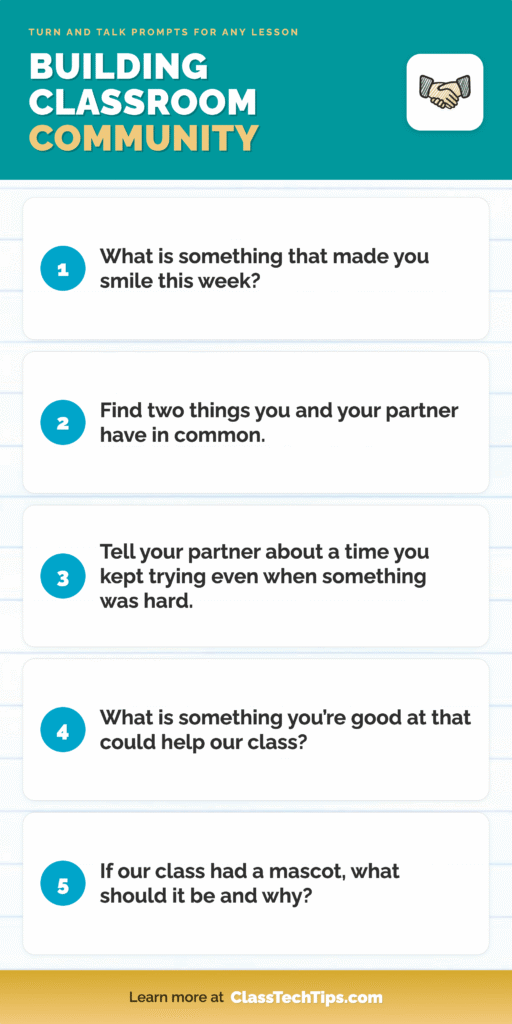
Building Classroom Community
Use these at the start of the year, during morning meetings, or anytime your class needs to reconnect.
- What is something that made you smile this week?
- Find two things you and your partner have in common.
- What is one thing you’re looking forward to today?
- Tell your partner about a time you kept trying even when something was hard.
- What does a great listener look like and sound like?
- What is one way we can make our classroom a place where everyone feels welcome?
- What is something you’re good at that could help our class?
- If our class had a mascot, what should it be and why?
Getting Ready to Learn
Try these before a new lesson or unit to activate background knowledge and spark curiosity.
- What do you already know about today’s topic?
- Look at this image or title. What do you notice? What do you wonder?
- Make a prediction. What do you think we’ll learn today?
- Where have you seen or heard this word or idea before?
- What is one thing from our last lesson that might help you today?
- How would you explain yesterday’s lesson to someone who was absent?
- On a scale of 1 to 5, how confident do you feel about this topic? Explain why.
- What is one question you hope we answer today?
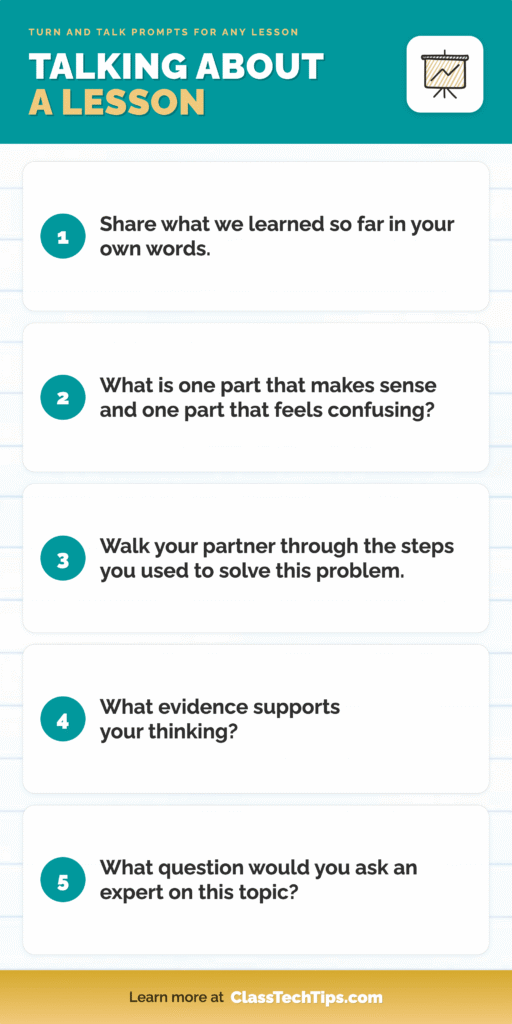
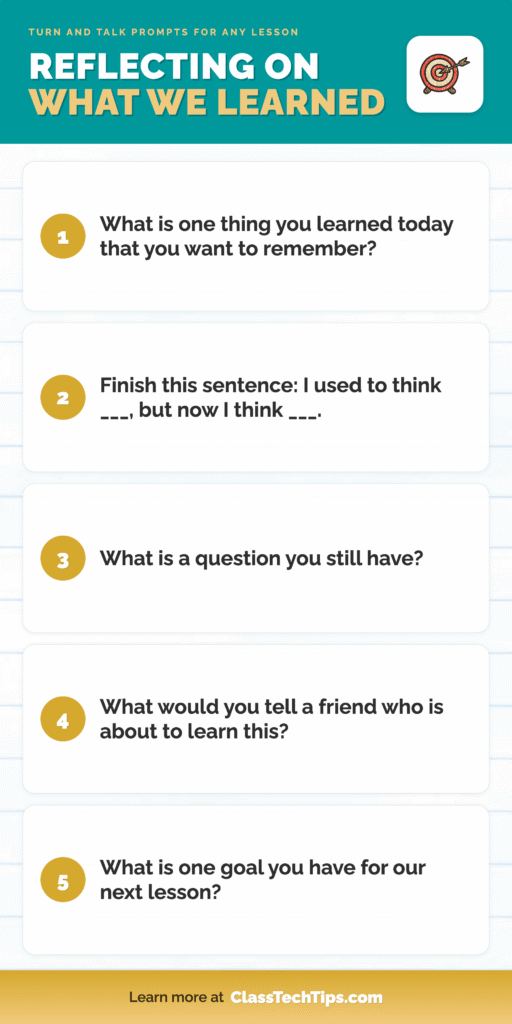
Talking About a Lesson
Pause in the middle of a lesson with these prompts to help students process new information.
- Share what we learned so far in your own words.
- What was the most interesting or important thing you heard in the last five minutes?
- What is one part that makes sense and one part that feels confusing?
- Walk your partner through the steps you used to solve this problem.
- Do you agree or disagree with this idea? Why?
- What evidence supports your thinking?
- How could you check whether your answer makes sense?
- What question would you ask an expert on this topic?
Making Connections to Our Learning
These prompts help students see how new ideas fit with what they already know and the world around them.
- How does this connect to something we learned earlier this year?
- Where might you see this outside of school?
- How does this remind you of a book, movie, or show?
- How is this similar to or different from what we studied last week?
- Who would find this information useful and why?
- How could this idea help solve a problem in our school or community?
- How does this connect to your own life or experiences?
- What might change if this idea or event never happened?
Reflecting on What We Learned
Wrap up a lesson with these prompts, or use them as a verbal exit ticket before students leave.
- What is one thing you learned today that you want to remember?
- Finish this sentence: I used to think ___, but now I think ___.
- What was the trickiest part of today’s lesson, and how did you work through it?
- What is a question you still have?
- What would you tell a friend who is about to learn this?
- What helped you learn best today?
- How has your understanding changed since the start of class?
- What is one goal you have for our next lesson?
Tools for Timing and Pairing Turn and Talk Conversations
A great prompt is the first step. The next step is making sure conversations stay focused and every student has a partner. Here are three ways EdTech tools can help.
Keep Conversations on Track with Classroomscreen Timers
If you’ve joined me for a webinar or workshop, I often use the timer Aftel.net which I think I first heard about from Tony Vincent. This online tool is free and you can pull it up on your browser, meaning its easy to share on a “big screen” of your classroom.
You might not use it all of the time, but it is a good option for practicing taking turns by giving each partner a set time to share their idea before jumping into a more fluid conversation. Try giving each partner 45 to 60 seconds to share. When the timer sounds, the second partner takes over.
Mix Up Partners with a Random Partner Picker
Talking with the same shoulder partner every day can get a little stale. Last year, I partnered with Grouper for a post on “How to Group Students Quickly and Strategically” With this tool, you can set the group size to two for instant pairs, and use the Do Not Group With setting to prevent certain combinations when you need to.
If you do want certain students to work together more often, there is an option for that, too. You can also turn on Study Buddies to keep specific students together for extra peer support.
Capture Share-Outs in a Digital Space
Not every conversation needs a whole-class share-out, but sometimes you’ll want a record of what students discussed. Padlet is a great fit here. Create a board using the Columns format with one column for each prompt or one column for each pair of students.
After a turn and talk, partners can add a quick post summarizing their idea. Students can type a response or record audio or video, which gives them options for how they share. Classmates can read and react to each other’s posts, and you have a snapshot of student thinking to look back on when planning your next lesson. I partnered with Padlet for a post earlier this year, titled “5 Things You Might Not Know About Padlet” which includes more ideas.
Getting Started with Turn and Talk Prompts
You don’t need to use all 40 turn and talk prompts this week, this month or even this year. Instead, start small by picking one category and displaying one prompt. Once students know the routine, try adding a random partner picker or a Padlet share-out.
And of course, if you have more prompts you would add to the list, I’d love to hear them! Reply to my Monday newsletter (sign up here for free) and let me know your favorites.