This summer I had the chance to lead a session for a fantastic group of educators who all had one thing in common: they love a good book study. We started off sharing some of our favorite books to use with students. Then we jumped right into ways to get some help from AI-powered tools to design a book study for your students.
Now, using AI for book studies doesn’t mean handing the reading experience over to a chatbot. It means using a few tools intentionally to accomplish goals like building context, sparking conversation, and designing the kind of reading experiences that stick with students. As a classroom teacher, with only so many hours in the day, I had plenty of things I wished I could do but simply didn’t have the time for. When I think of the power of artificial intelligence in the hands of an educator, it’s really about taking care of items on your wish list in addition to tackling items on your to-do list.
This session was all about scaling your impact with the help of AI. And it connects to three of the twelve essentials in my book EdTech Essentials: Generate, Assess, and Create.
Today on the blog, I will walk you through ten of my favorite ways to bring AI into your next book study. And I’ve included with a spotlight tool and sample prompts or instructions to try with these tips, too.
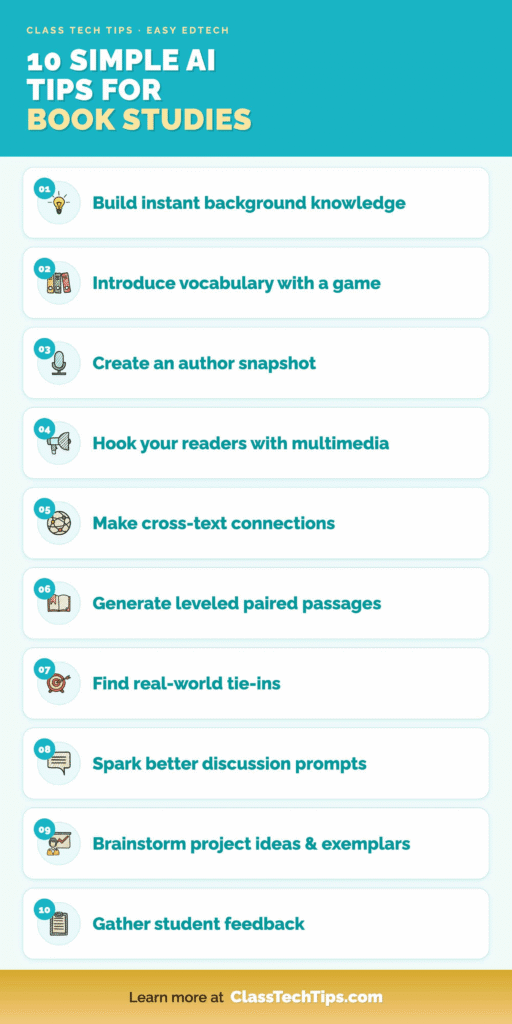
10 Simple AI Tips for Book Studies
Whether you are brand new to AI or you have been experimenting for a while, these strategies are designed to be easy entry points. Pick one to try with your next read, then add more as you go. You can use a favorite chatbot like Gemini, ChatGPT, or Copilot, along with a handful of tools I will spotlight below.
1. Build Instant Background Knowledge
A book study can begin before you even open the first page of a book. You can ask an AI-powered tool to generate a one-page, grade-level primer on a book’s setting, era, or central topic. This overview can help students start a book study with some context already in place. For this tip, you can try Gemini or any chatbot. It can put together a kid-friendly overview you can tweak and refine before sharing with students.
Try this prompt: “Write a one-page background primer for 5th graders on the Dust Bowl era, including 3 key facts and 2 questions to think about before reading.”
2. Introduce Vocabulary with a Game
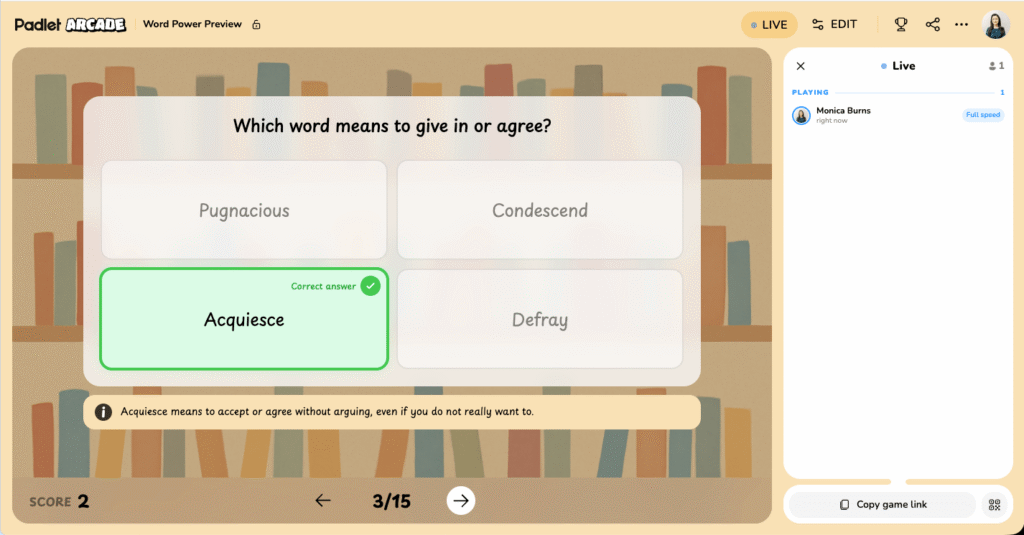
You can introduce new vocabulary to students through a game. Try using Padlet Arcade, an AI-powered tool to create a quick game that introduces a handful of words students will meet in the book. Padlet Arcade makes it easy to set up a playful review activity. You can use this strategy to get students interacting with new words before they read.
Try this prompt: “Create a matching game with 8 vocabulary words and student-friendly definitions for a middle school novel about survival in the wilderness.” Alongside your prompt you can paste a vocabulary list or upload a PDF of vocabulary words if you like.
3. Create an Author Snapshot
An author snapshot can take a variety of forms. With NotebookLM you can upload a handful of resources about an author’s life into a Notebook. Then you can use the Studio panel to make a few different types of AI-generated content. You might create an infographic, a short explainer video, or an audio overview with the help of AI.
Try this feature: Use the infographic tool, and in the “customize” box explain that you want a timeline that follows important events in the author’s life.
4. Hook Your Readers with Multimedia
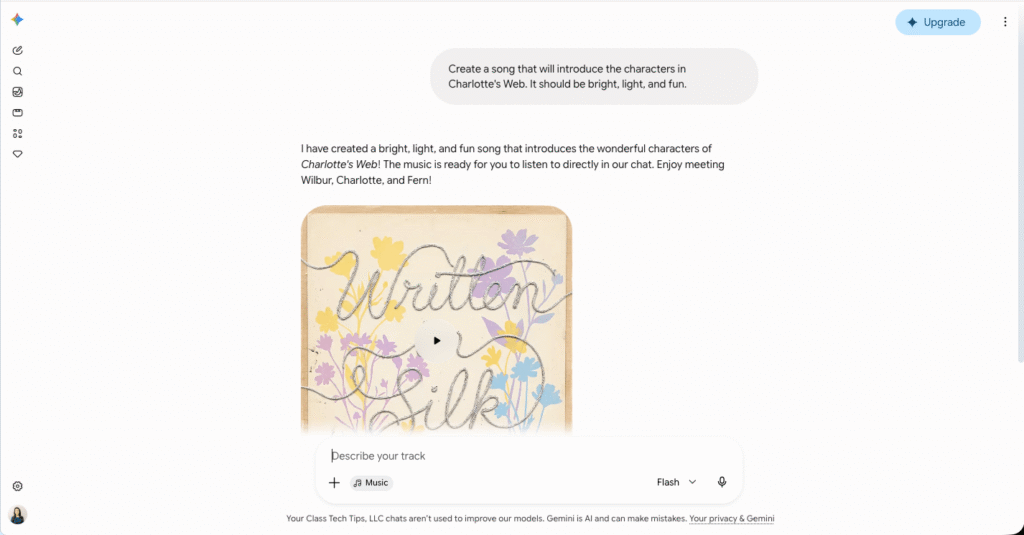
You can use AI-generated audio and video to build excitement and get students curious about a new book. You might create a song with ElevenLabs or Gemini, or a short video with Canva’s AI tools.
Try this strategy: Use the “Video Clip” option in Canva AI and describe the opening scene of a book you are about to introduce to students. Create the video and share with your class.
5. Make Cross-Text Connections
Help your readers connect what they’ve read in a book study to other texts. You can create a custom Gem in Gemini that suggests similar books, poems, or articles to pair with your current read. With a reusable Gem, you can generate text-to-text connections for any book your class tackles this year.
Try this tip: When creating your Gem, give examples of the types of texts you like to share with students. This will help it give you stronger recommendations.
6. Generate Leveled Paired Passages
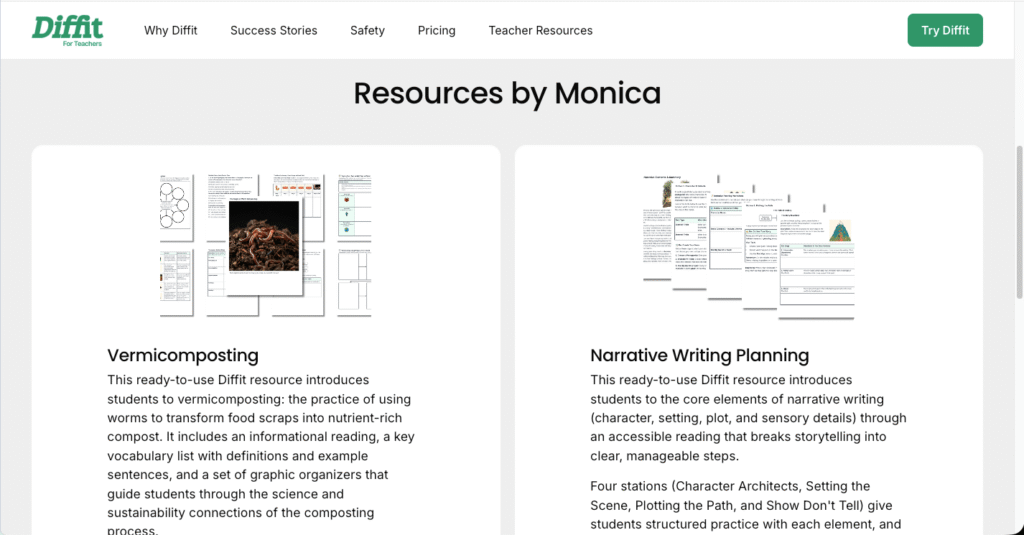
Pairing a novel with a nonfiction passage can deepen a student’s interaction with the story. Finding the perfect text at a “just right” reading level can be a challenge. Diffit lets you create leveled, paired passages on topics connected to a book’s theme, so every student gets a text they can access.
Try this tip: Head over to the custom lessons I created with Diffit to see what this tool can do.
7. Find Real-World Tie-Ins
Help students see how a reading experience connects to today. Use an AI chatbot to identify current events or careers linked to a book’s themes. A chatbot like Duck AI can help you find timely connections that make a story feel relevant right now.
Try this prompt: “Find 3 real-world careers or current events connected to a book about environmental activism, with a one-sentence explanation of each.”
8. Spark Better Discussion Prompts
The best book discussions start with the right questions. Ask AI for open-ended, debate-worthy prompts with no single right answer. This can push students to have a deeper dialogue about what they’re reading. If this is something you do with students frequently, you could even build a Gem for this repeatable task.
Try this prompt: “Give me 5 open-ended discussion questions for chapters 1–3 of [add book title]. The questions should have no single right answer and encourage students to defend their thinking.”
9. Brainstorm Project Ideas and Exemplars
When it is time to wrap up a book study, AI can help you map out the final project. Use ChatGPT to brainstorm project ideas for your class. Depending on the project you have in mind, a chatbot may even be able to create exemplars so students can picture their final product before they begin.
Try this prompt: “Suggest 4 project options to conclude a novel study about immigration, and describe what a strong example of each would include.”
10. Gather Student Feedback
Once your group is finished with a book, ask students to share what they thought. Create a quick survey or form to gather feedback on the book and the experience. The Jotform Quiz Maker makes it easy to build a student-friendly form and see the results at a glance.
Try this prompt: “Create 5 short survey questions to ask middle schoolers what they thought of [add the title of your class novel] and what they want to read next.”
Getting Started with AI for Book Studies
It was a lot of fun leading a webinar about this topic for educators earlier this summer. The ideas above are starting points. When using a chatbot or AI-powered tool, the more specific you are about your grade level, your students, and the book you are reading, the more useful the results will be.
Want more ideas like these delivered to your inbox? Every Monday I send out a free newsletter packed with EdTech tips and ready-to-use resources for educators. Sign up here so you do not miss a thing, and check out my AI resources page for even more strategies to explore.
And if you would like to bring a conversation like this to your school or district, I’d love to join you. You can learn more about my workshops and webinars on this page. Whether it is in person or virtual, I love working alongside educators to share tips and strategies they can use right away!