Do you have a system or routine for checking in with students during the school week? If you’re looking for a quick way to take the pulse of your classroom, there are a few strategies to consider. A simple routine gives students a voice and gives teachers useful information at the same time.
Check-in questions can accomplish both of these goals. A few quick questions at the start of class, at the end of the week, or after a long break can help you plan. They can help you determine your next steps for a lesson, build a stronger classroom community, and make sure every student has a chance to share.
Today on the blog, I’m sharing 50 check-in questions for students organized into daily, weekly, and after-break sets. I’ve also included tips for turning them into a reusable Google Form.
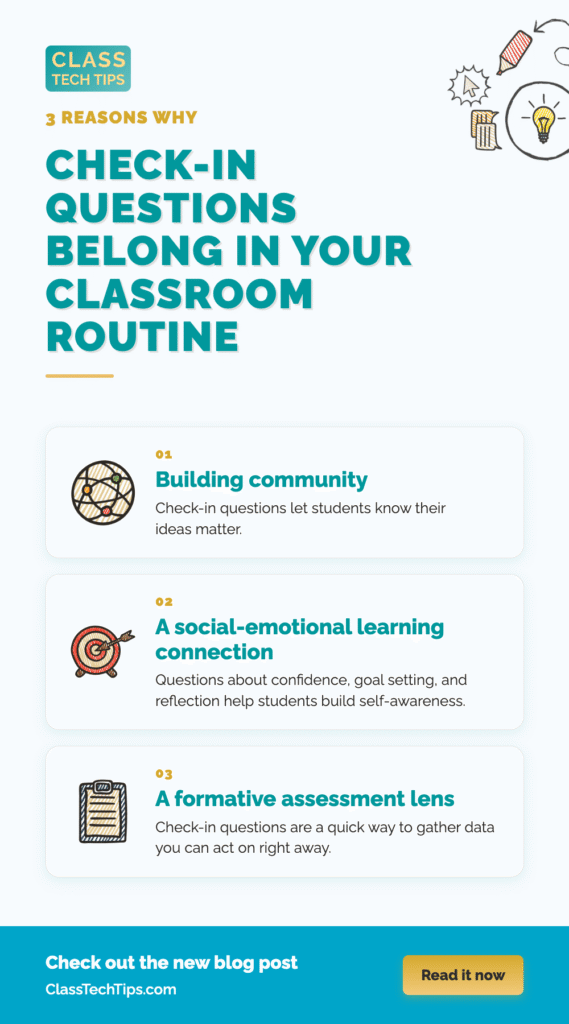
Why Check-In Questions Belong in Your Classroom Routine
Check-in questions work well any time of year, but they’re a great routine to start at the beginning of the school year, the start of a new term, or the first week of a new unit. These are natural moments to set expectations and learn what students already know. A consistent routine also makes it easier for students to know what to expect each time a check-in pops up.
The questions in this post are general on purpose. They focus on learning, goals, and classroom experiences rather than personal details. You can customize them for your students, and even though I’ve included a few tech connections, it’s up to you how you share them with your group.
Building Community
Check-in questions let students know their ideas matter. When you ask which activity they enjoyed most or how they worked with a partner, you send the message that this is our classroom. Check-ins are a simple way to put that idea into practice. If you want to take these ideas off the screen and into a group discussion, my list of 40 Discussion Questions for Students to Spark Conversations is worth checking out.
Extra resource: Tim Needles talked about the power of student voice in an episode of my Easy EdTech Podcast. Check out Art, Technology, and Student Voice in the Classroom.
A Social-Emotional Learning Connection
Questions about confidence, goal setting, and reflection help students build self-awareness. When a student rates how ready they feel to learn or names a strategy they’ll try if they get stuck, they’re practicing important SEL skills. You could stick with the same reflection questions each week or switch them up over the course of the school year.
Extra resource: Michele Haiken shared great ideas on this topic in the episode Strengthen SEL Skills During Any Project with Michele Haiken on the Easy EdTech Podcast.
A Formative Assessment Lens
Check-in questions are also a quick way to gather formative assessment data. Asking what students remember from yesterday or which topic they’d like to review gives you information you can act on right away. If assessment is front of mind for you, this might be your main reason for creating a set of check-in questions.
For more ideas, take a look at my post on Simple Formative Assessment Strategies for Teachers, or check out the “Assess” chapter in EdTech Essentials.
Check-In Questions and the Assess Chapter of EdTech Essentials
In the Assess chapter of my book, EdTech Essentials: 12 Strategies for Every Classroom in the Age of AI, I talk about using Google Forms (or any form tool) before a lesson. This gives students a chance to share what they already know, what they’re excited about, or what interests them about a new topic. Those responses can shape how you introduce a unit, group students, or choose examples that connect with their interests, too.
If you already have the book, download my free study guide with reflection and discussion questions for every chapter. It’s perfect for a book study with colleagues, too. You can also hear more about the book in the episode What’s New in the Second Edition of EdTech Essentials of my Easy EdTech Podcast.
For the questions on this list, you can model how you would answer each question before giving it to students the first time. You can also share why you’re asking a question and what you plan to do with student responses. You may also want to make questions optional or give students a choice between two questions. It all depends on your goal for checking in with students.
Daily Check-In Questions for Students
These quick check-in questions work well as a warm-up at the start of class. Pick one or two to begin, and add more to your routine over the course of the school year.
1. On a scale of 1 to 5, how ready do you feel to learn today?
2. What is one thing you remember from yesterday’s lesson?
3. What is one question you have about today’s topic?
4. How confident do you feel about today’s skill?
5. Which of these topics [list your topics] would you like to review?
6. What do you already know about today’s topic?
7. Would you like to work on your own, with a partner, or in a small group today?
8. What is one word that describes how you feel about today’s topic?
9. What is one goal you have for today’s class?
10. What might help you do your best work today?
11. How well did you understand yesterday’s practice activity?
12. What is one vocabulary word from this unit you could explain to a classmate?
13. What part of yesterday’s lesson felt the easiest?
14. What part of yesterday’s lesson felt the trickiest?
15. What is one thing you’re curious about today?
16. How would you like to show what you know today: writing, drawing, or recording?
17. What strategy will you try if you get stuck today?
18. How much energy do you have for learning right now?
19. What is one thing you’re looking forward to in class today?
20. Is there anything you’d like me to know before we start?
Weekly Check-In Questions for Students
Weekly check-ins give students a chance to look back and plan ahead. Friday is a natural fit, but if Fridays feel a little full, Thursday or any day that works for your schedule is a great choice.
21. What is something new you learned this week?
22. What was your favorite activity this week, and why?
23. Which skill from this week would you like to practice more?
24. How well did you understand each topic we covered this week?
25. What helped you learn best this week?
26. What is one thing you’re proud of from this week?
27. How did you work with a partner or group this week?
28. What is one question you still have from this week?
29. How well did you meet the goal you set this week?
30. What is one goal you have for next week?
31. Which resource or tool was most helpful this week?
32. How did you feel about the pace of class this week: too fast, about right, or too slow?
33. What would you like to learn more about next week?
34. If you could give our class a shout-out for something this week, what would it be?
35. What is one tip you would give a classmate for next week’s work?
After-Break Check-In Questions for Students
Coming back from a long weekend, winter break, or spring break? These check-in questions help students reconnect with learning and help you see where to start.
36. What do you remember from the unit we finished before the break?
37. How ready do you feel to jump back into learning?
38. Which class routine would be helpful to review together?
39. What is one skill from before the break you feel confident using?
40. What is one skill you’d like a quick refresher on?
41. What are you curious about in our next unit?
42. What do you already know about our next topic?
43. What is one goal you have for the rest of this term?
44. What helps you get back into a learning routine?
45. How confident do you feel about each of these topics [list your topics] from before the break?
46. What is one way our class could work well together this term?
47. Which type of activity would you like to see more of this term?
48. What is one question you have about what’s coming up next?
49. What is one book, game, or activity you’d recommend to the class? (optional)
50. Is there anything you’d like me to know as we start this new stretch of learning? (optional)
Building a Reusable Google Form for Check-In Questions
Once you’ve picked your favorite check-in questions, a Google Form makes it easy to collect responses and spot patterns. Create one form with a few core questions, then make a copy each time you want to use it with a new class, unit, or week.
Make a copy of my reusable check-in questions Google Form >>
Form tools have lots of question types to choose from, including:
- Likert scale: Great for confidence and readiness questions, like rating how ready you feel to learn on a scale of 1 to 5.
- Open-ended response: Perfect for questions about what students already know or what they’re curious about.
- Multiple choice: Helpful when you want students to pick a topic to review or a preferred way to work, or when they might get stuck staring at an empty text box.
- Grids: A good option when students rate their understanding of several topics at once, though they may overwhelm some students.
The right question type depends on the question you’re asking and the choices you want to give students. A mix of quick taps and short written responses keeps check-ins fast while still giving you meaningful information.
If you’re new to building forms, my posts on 12 Unexpected Ways to Use Google Forms and How to Make a Checklist with Google Forms in Just a Few Steps walk through more ideas.
Google Forms isn’t the only option, though. I’m a big fan of Jotform, and I’ve partnered with them on lots of podcast episodes this year. Jotform also has templates, conditional logic, and plenty of question types that work well for check-ins.
Take a look at Everything You Need to Know About Jotform for Teachers and 10 Things You Might Not Know About Jotform for Teachers to learn more. As you build your form, keep accessibility in mind so every student can respond. Alper Donmez shared helpful ideas in this bonus episode of the podcast How Jotform Is Making Forms Accessible for Everyone.
Getting Started with Check-In Questions
You certainly don’t need to use all 50 check-in questions at once. Start small by choosing two or three questions from one set, adding them to a form, and trying them with one class this week.
Keep check-in questions focused on learning, and avoid asking for sensitive personal information. Follow your school or district’s guidelines for student data, using only school-approved tools and accounts.
The responses will help you plan with purpose and show students that their voices matter. If you try this routine, I’d love to hear how it goes! Sign up for my weekly newsletter and reply to my email with your thoughts, ideas, and questions.